
Recovery that adapts with every movement
We designed the experience framework for a connected XR rehabilitation system with advanced hand tracking and real-time motion analysis — so patients get feedback that adapts as their mobility changes, and clinicians get objective data instead of a subjective progress note.
- Client
- SpectreXR
- Industry
- HealthTech
- Services
- Discovery & design
- Team
- 2 members
The challenge
Hand rehabilitation still depends on subjective assessments, static therapy plans and tools that lack precision or real-time tracking.
Clinicians are limited by manual measurement, while patients get exercises that fail to adapt to their evolving mobility. At the same time, healthcare systems face a shortage of rehabilitation specialists and growing pressure to deliver measurable outcomes.
Manual assessments slow clinical decisions by up to 50%.
One-size-fits-all therapy lowers engagement and delays recovery by 30–40%.
Around 60% of patients lack access to consistent, high-quality rehabilitation.
What we built
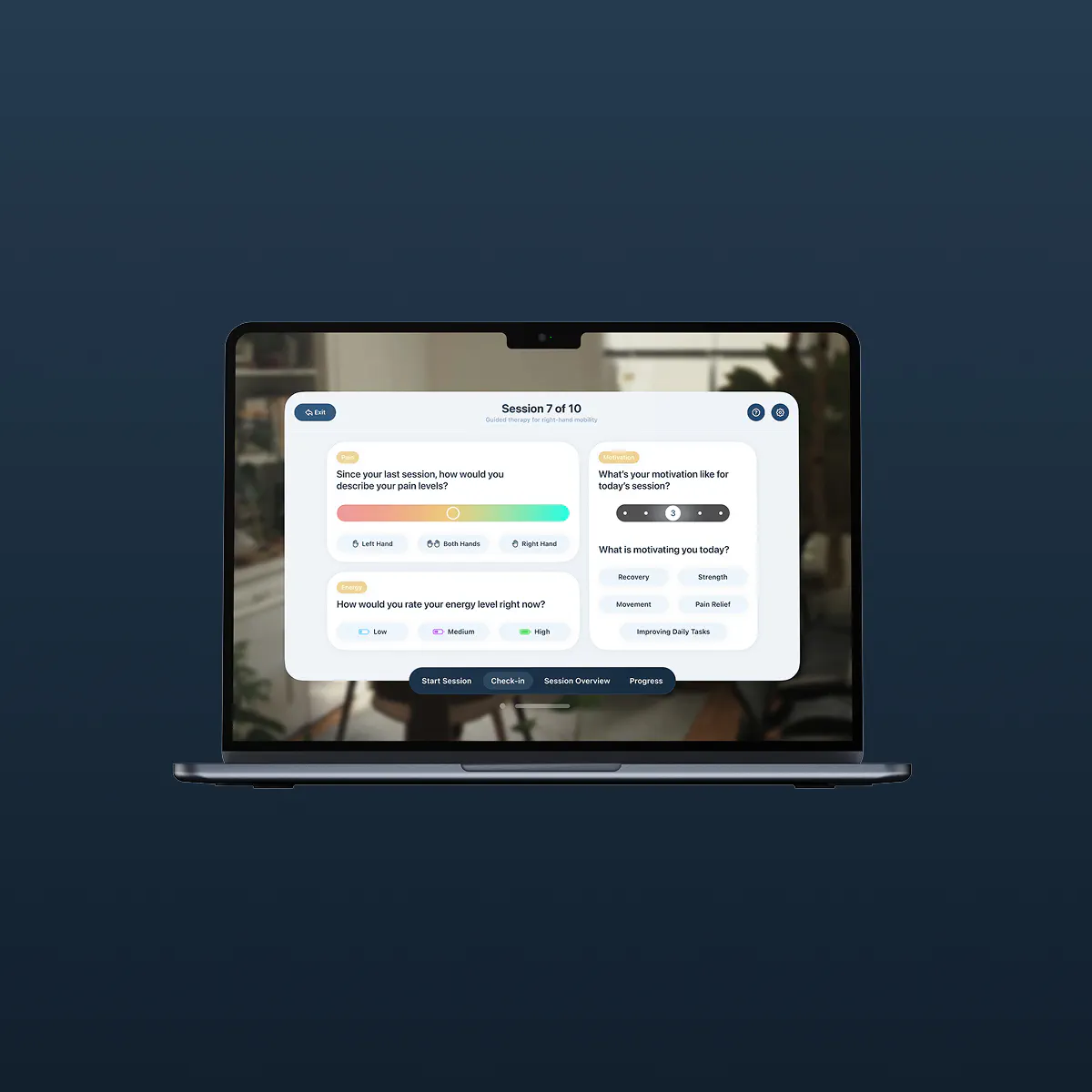
A connected XR rehabilitation experience, linking the patient's therapy to a clinician interface.
XR combines virtual and augmented reality into immersive therapeutic environments that boost engagement and make interaction intuitive. The patient's XR sessions sync with a clinician interface for session planning, real-time monitoring and automated progress insights.
Physics-based hand tracking
Built on OctoXR, SpectreXR's platform — capturing joint angles, trajectories and grip dynamics with precision.
Adaptive feedback engine
Exercises adjust to each patient's progress instead of following a static plan.
Clinician analytics
An analytics layer visualizes improvement trends and therapy outcomes, so therapists can evaluate performance accurately.
Data that reshapes care
Objective insights
Precise motion metrics replace subjective assessments.
Faster recovery
Immersive exercises and real-time feedback keep patients engaged.
Lower workload
Automated tracking and insights reduce clinician effort.
Scalable therapy
Standardized, data-driven sessions enable consistent care at higher volume.
Recovery measured continuously — not only during an occasional appointment.